Brazil has almost 30,000 exporters.
Most of them are not the household names. This guide shows who they are by size, how fast the number is growing and which sectors a Brazil buyer can reach. It then gives a way to find an exporter and five checks to run before you send a deposit.
Who Are Brazil's Exporters?
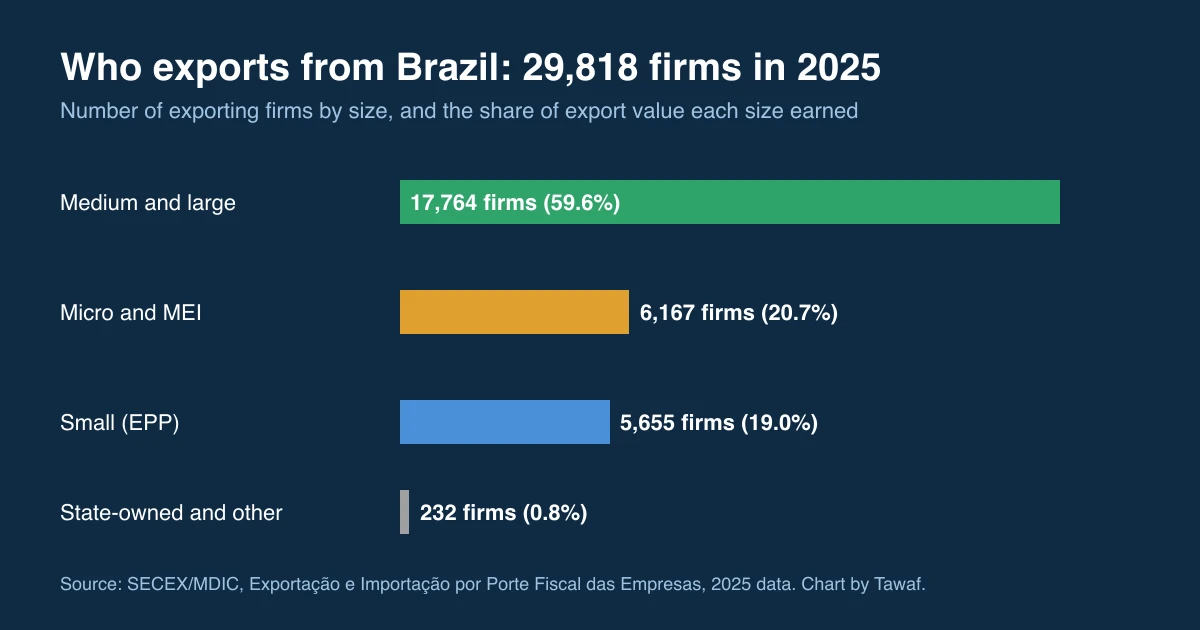
A Brazilian exporter is a company registered with a CNPJ tax number that sells goods abroad. Brazil had 29,818 of them in 2025, according to the trade ministry's statistics arm, SECEX/MDIC. Medium and large firms were 17,764 of that count, or 59.6%, while micro and small firms made up the rest.
SECEX counts firms by the first eight digits of the CNPJ, so a head office and its branches count once. It sorts them by the tax size they declare. The table shows the 2025 split, using SECEX's report on exports by company size, announced on its statistics notice page.
| Firm size |
Exporting firms |
Share of firms |
Export value |
Share of value |
| Micro and MEI |
6,167 |
20.7% |
US$0.87 billion |
0.3% |
| Small (EPP) |
5,655 |
19.0% |
US$1.81 billion |
0.5% |
| Medium and large |
17,764 |
59.6% |
US$320.92 billion |
92.1% |
| State-owned and other |
232 |
0.8% |
US$24.68 billion |
7.1% |
| Total |
29,818 |
100% |
US$348.28 billion |
100% |
Source: SECEX/MDIC, "Exportação e Importação por Porte Fiscal das Empresas", 2025 data, read on 22 November 2026 at balanca.economia.gov.br/balanca/outras/porte/relatorio_porte.html. MEI is Brazil's individual micro-entrepreneur status. The total here is on SECEX's company-size basis and can differ slightly from the headline trade figure.
Look at the last two columns together. About four in ten Brazilian exporters are micro or small, yet together they sold only about US$2.7 billion, by our arithmetic from the table. Medium and large firms sold more than 92% of the value.
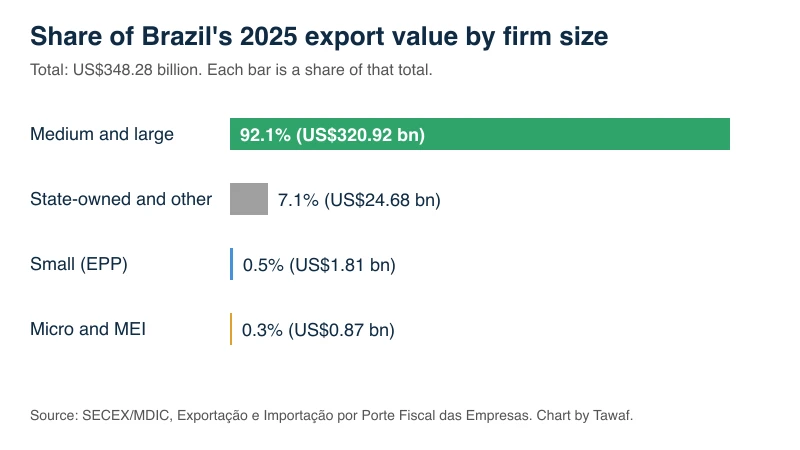
For a buyer, that gap is the point. A small exporter is not a shrunken version of Vale or JBS. It sells in lots a small importer can actually buy.
How Many Brazilian Companies Export, and Is the Number Growing?
Yes, it is growing. SECEX/MDIC counted 29,818 exporting firms in 2025, up from 28,524 in 2023 and 19,786 in 2008. That is about 51% more exporters than in 2008, by our calculation. The count fell to a low of 18,220 in 2012 before climbing again.
The chart traces the full series from the same SECEX/MDIC report.
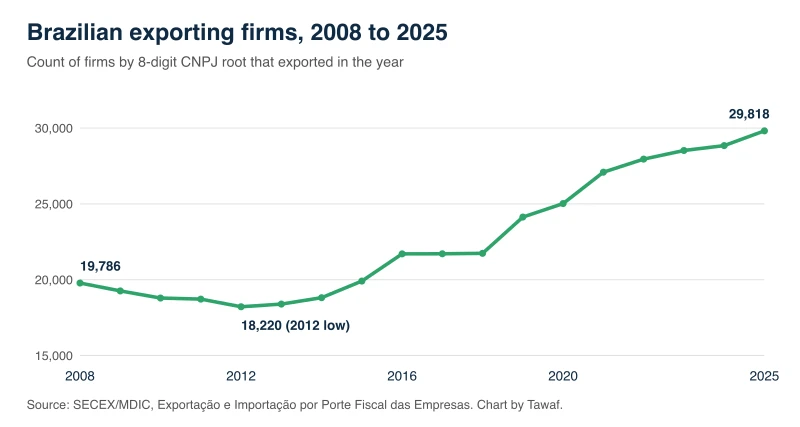
The recent climb is not only a story of big firms. In 2025, micro and MEI exporters grew 3.6%, small exporters 3.2% and medium and large exporters 3.4%, per SECEX. More new names means more choice for you. It also means more firms with a thin track record.
That is why the checks later in this guide matter. A growing pool is good for buyers only if you can tell the real exporters from the hopeful ones.
Which Sectors Do Brazil's Exporters Cover?
Brazilian exporters cover far more than commodities. ApexBrasil's Buy Brazil platform sorts 17,000+ listed products into 17 industry groups, from agribusiness and food to machinery, plastics, fashion and healthcare. Its directory lists 2,000+ Brazilian companies, so a buyer can search by industry, product or HS code.
Those figures come from the Buy Brazil directory at buybrazil.com, read on 22 November 2026. It is run by ApexBrasil, Brazil's export promotion agency.
The giants dominate the headlines. Petrobras sells crude oil, Vale sells iron ore and JBS sells beef. Soybean traders such as Cargill, Bunge and ADM ship grain by the shipload. These firms deal with other large companies, and they rarely have time for a first-time buyer with one container to fill.
The openings are lower down. Coffee roasters and cooperatives, sugar mills, fruit and juice packers, leather and footwear makers, and machinery builders all sell in container-sized lots. Our guide to Brazil's main export ranks the products by value and shows who buys them.
Match the product to the exporter's size. A micro exporter fits a sample order or a first container. A medium firm fits a repeat programme. A large trader fits a standing contract.
How Do You Find Brazilian Exporters?
Start where Brazilian exporters list themselves. Buy Brazil lets you search by product or HS code and request quotes from listed suppliers at no cost. Its operator, ApexBrasil, says it only helps buyers and sellers make first contact and does not mediate negotiations. Then add sector associations, trade fairs and a B2B marketplace.
Four routes work, and they work best together.
- Buy Brazil. The platform lists companies that ApexBrasil supports. Use the HS code search if you know your product code.
- Sector associations. Trade bodies know their members. Cecafé covers coffee exporters and ABIEC covers beef exporters. Write to the secretariat and ask for member contacts.
- Trade fairs. Buy Brazil also publishes catalogues of Brazilian exhibitors at international fairs, so you can see who is already selling abroad.
- A business marketplace. Post a free "Looking For" request on Tawaf and let suppliers come to you with quotes. You describe the product, grade and volume once instead of emailing fifty firms.
Need a Brazilian supplier for your next order?
Post a free "Looking For" request on Tawaf and compare the quotes that come back. Get started here.
Takes a few minutes. Free. No obligation to buy.
Whichever route you use, treat a directory listing as an introduction, not a reference. Buy Brazil itself says it does not take responsibility for the outcome of any deal. Do your own checks.
How Can You Check That a Brazilian Exporter Is Real?
Run five checks before you pay a deposit: company identity, export record, product approvals, quality proof and references. Brazil's tax authority runs a public customs-authorisation lookup, and since 31 August 2026 it sits on the Portal Único Siscomex. A company that cannot show authorisation to operate in foreign trade should not get your money.
The authorisation is called RADAR. The Receita Federal's notice on the lookup says the old page closes on 30 September 2026. The check now runs through the public Portal Único Siscomex lookup.
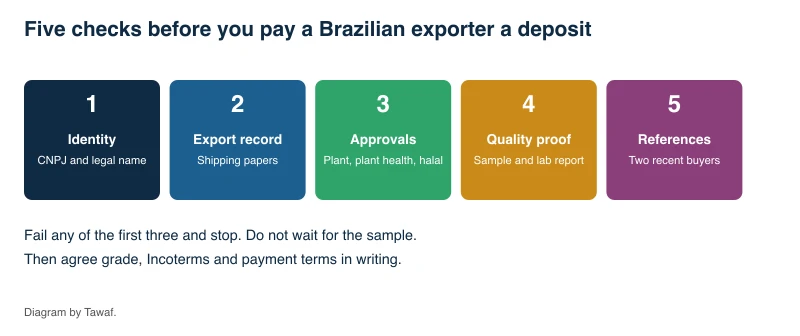
Use the table as your working list. Each row pairs a check with the red flag that should stop you.
| Check |
What to ask for |
Red flag |
| Company identity |
CNPJ number, legal name and address. Look up the CNPJ on the federal tax authority's public search |
Details that do not match, or a request to pay a personal account |
| Export record |
Authorisation to operate in foreign trade (RADAR), plus recent bills of lading with customer names hidden |
No export history, or no shipping papers to show |
| Product approvals |
Meat: the plant's federal inspection number, checked against your country's approved-plant list. Plant products: a phytosanitary certificate. Halal goods: a certifier your authority recognises |
Certificates with no issuer or date |
| Quality proof |
A pre-shipment sample and an independent lab or inspection report |
Brochure only, or refuses to send a sample |
| References |
Two recent buyers, ideally in your region |
Only testimonials on the supplier's own site |
A real exporter expects these questions. Vague answers to the first three are a reason to walk away. Our guide to verifying suppliers covers the general process, and why verification matters in B2B explains the reasoning. If you buy halal meat or food, read the halal certification guide first.
What Should You Agree Before You Pay a Brazilian Exporter?
Agree six terms in writing before any money moves: product grade, minimum order, Incoterms, price validity, payment schedule and currency. Brazilian quotes are often FOB or CIF a port such as Santos or Paranaguá. Keep the balance until an independent inspector confirms quantity, grade and packaging against the approved sample.
Grade matters most for commodity goods. If the contract says only "coffee" or "sugar", you cannot reject a weaker lot. Name the grade and attach the spec.
Then settle the logistics. Our guides to Incoterms, negotiating with suppliers and international payment methods explain each term. For bigger orders, read trade finance for SMEs.
Order a sample before a container. Then hire an inspector for the full lot, using our quality control guide for importers.
Tawaf's threaded inquiry system keeps your spec, quotes and sample approvals in one conversation. That helps if you later need to show what was agreed.
Which Brazilian Exporter Size Should You Choose?
Choose by order size, not by prestige. Our calculation from SECEX/MDIC's 2025 report gives an average of about US$141,000 per micro or MEI exporter and about US$320,000 per small exporter. Medium and large firms averaged about US$18 million each, so they usually expect bigger and more regular orders.
These are averages, and a few big shippers lift every group. Treat them as a rough guide to the scale each type works at.
The averages divide the 2025 export values by the firm counts in the same SECEX/MDIC report.
Here is how that plays out:
- First order or a test shipment. A micro or small exporter is more likely to quote a single container and to answer your email.
- Repeat programme. A medium firm usually has export staff, documents and steady capacity.
- Standing contract. A large exporter or trader can supply volume, but expect stricter terms and a higher minimum.
The trade-off is risk. Smaller firms often have thinner paperwork and less buffer if a harvest or shipment fails. Run all five checks on every size, and run them twice on a firm you have never heard of.
Frequently Asked Questions
How many exporters are there in Brazil?
Brazil had 29,818 exporting firms in 2025, according to SECEX/MDIC. That is up from 28,524 in 2023 and 19,786 in 2008. Of the 2025 total, 17,764 were medium or large, 6,167 micro or MEI, 5,655 small and 232 state-owned or other.
How do I find Brazilian exporters?
Search ApexBrasil's free Buy Brazil directory, which lists 2,000+ Brazilian companies and 17,000+ products and lets you search by HS code. Then add sector associations such as Cecafé for coffee and ABIEC for beef, trade fair catalogues and a B2B marketplace such as Tawaf.
Are Brazilian exporters mostly big companies?
By value, yes. Medium and large firms sold 92.1% of Brazil's 2025 exports, per SECEX/MDIC. By count, no. Micro and small firms were 11,822 of the 29,818 exporters, close to 40%. Smaller exporters are where first-time buyers often find lots they can afford.
How can I check if a Brazilian exporter is legitimate?
Ask for the CNPJ and look it up on the tax authority's public site. Then check the firm's authorisation to operate in foreign trade on the Portal Único Siscomex, whose public lookup replaced the old Receita page from 31 August 2026. Also ask for shipping papers and two buyer references.
What should I ask a Brazilian exporter before ordering?
Ask for the exact grade, minimum order, Incoterms, price validity, payment schedule and currency, all in writing. Request a sample first. Then pay the balance only after an independent inspector confirms quantity, grade and packaging against the approved sample for the order.
Keep Reading